
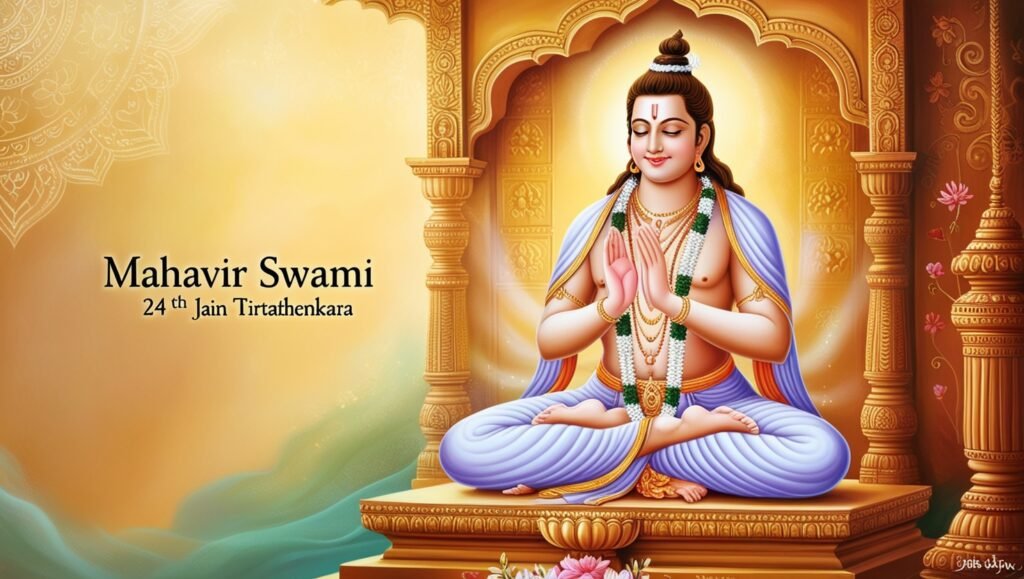
Welcome to our exploration of india’s most revered spiritual figures, MAHAVIR SWAMI, the 24th and last Tirthankara of Jainism. His life and teachings from the foundation of Jain philosophy offering a pathway to self-realisation, Non-violence and liberation from the cycle of Birth and Death.
Early Life of Mahavir Swami:
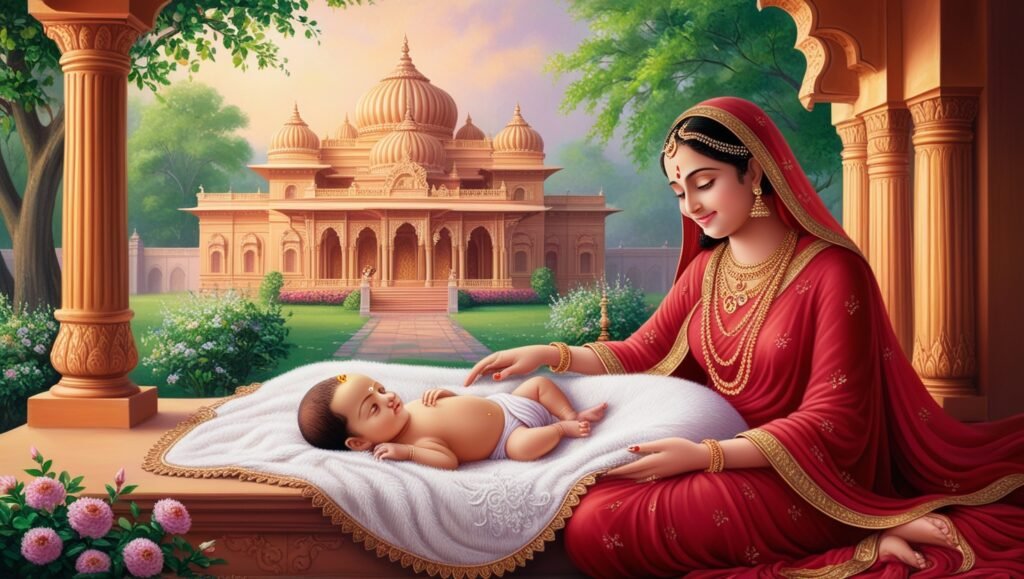
Mahavir Swami was born as Vardhaman in 599 BCE in the kingdom of Vaishali(Presently-Bihar) into the royal Kshatriya Family. His parents, King Siddhartha and Queen Trishala, were devout followers of Jainism.
According to Jain Traditions, his mother had 14 auspicious dreams before his birth, symbolizing the arrival of a divine soul. This dreams indicated that Vardhaman was destined for enlightenment.
- Signs of Spiritual Inclination :
Even during his youth, Vardhamana demonstrated an inclination toward detachment from worldly pleasures. His calm demeanour, compassion towards living beings and early wisdom indicated a life path beyond material wealth.
Renunciation of the World:
At the age of 30, despite being married and having a daughter Vardhaman Mahavir Swami renounced the world to pursue a path of spiritual enlightenment. His decision came from a deep realization that true peace and liberation could not be found from worldly attachment.
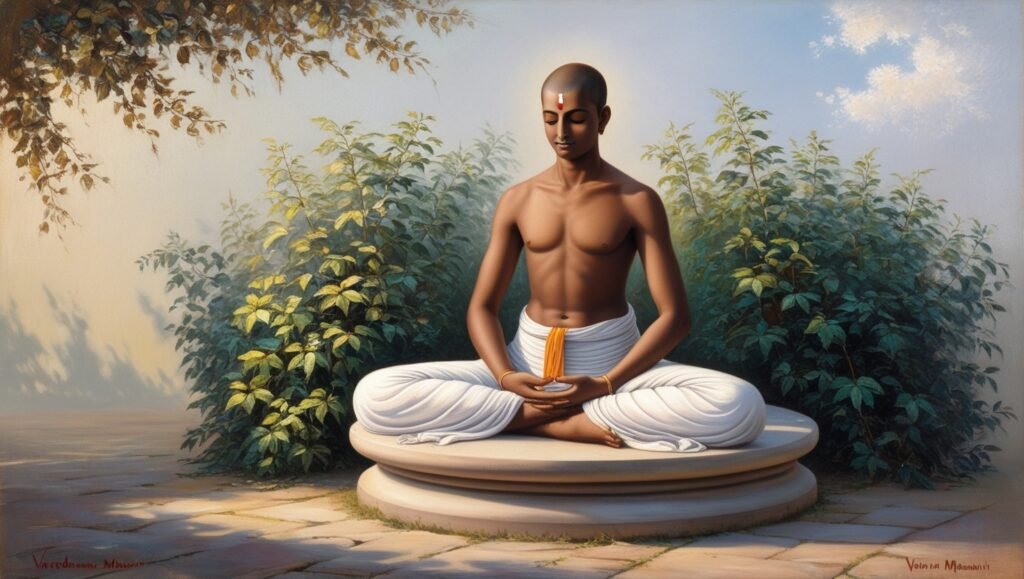
For the next 12 years, Vardhamana Mahavir Swami practiced severe asceticism, including meditation, fasting and self-discipline. He abom-doned all material possessions and practiced extreme forms of Non-Violence(Ahimsa), refusing even to harm the smallest insects.
Attainment of Kevala Jnana(Knowledge):
Enlightenment :
After 12 years of intense spiritual discipline, Vardhamana Mahavir Swami achieved Kevala Jnana(Omniscience) at the age of 42. This state is the highest form of knowledge in Jainism, where one understands the nature of the universe, karma and the path to liberation.
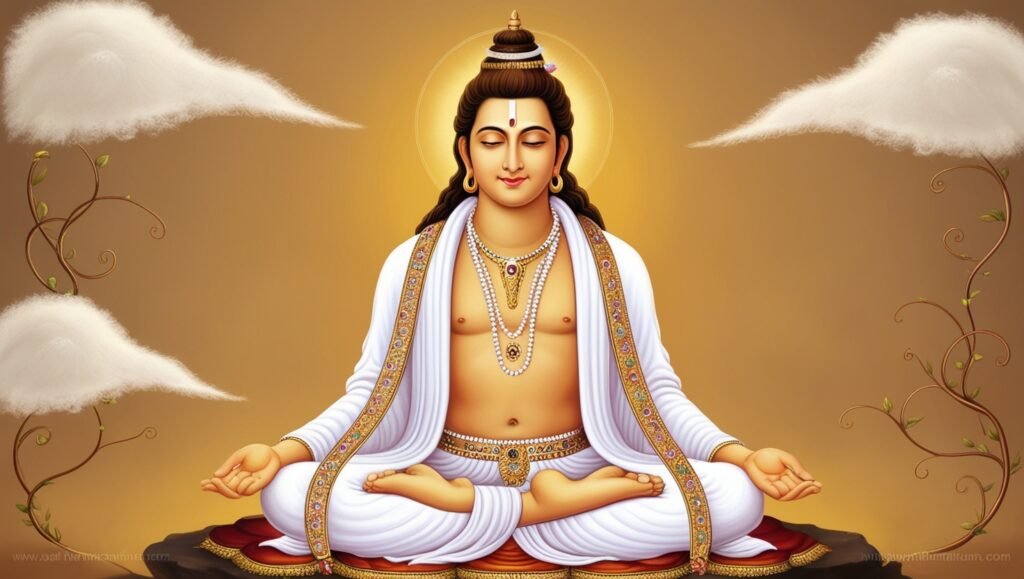
Upon attaining enlightenment, Mahavir Swami realized that the soul, when freed from karmic bondage, attains its pure, infinite state of bliss, knowledge and power.
The Teachings of Mahavir Swami:
>Ahimsa(Non-Violence)
The Cornerstone of Mahavir Swami’s teachings is Ahimsa. He preached that all living beings, regardless of their size or form, have souls and deserve compassion. Thus harm even in thoughts, words or actions is a violation of this principle.
Ahimsa extends all aspects of life, from one’s daily diet to relationships and interactions with the environment. The principles of non-violence in Jainism led to vegetarianism and great care toward all forms of life.
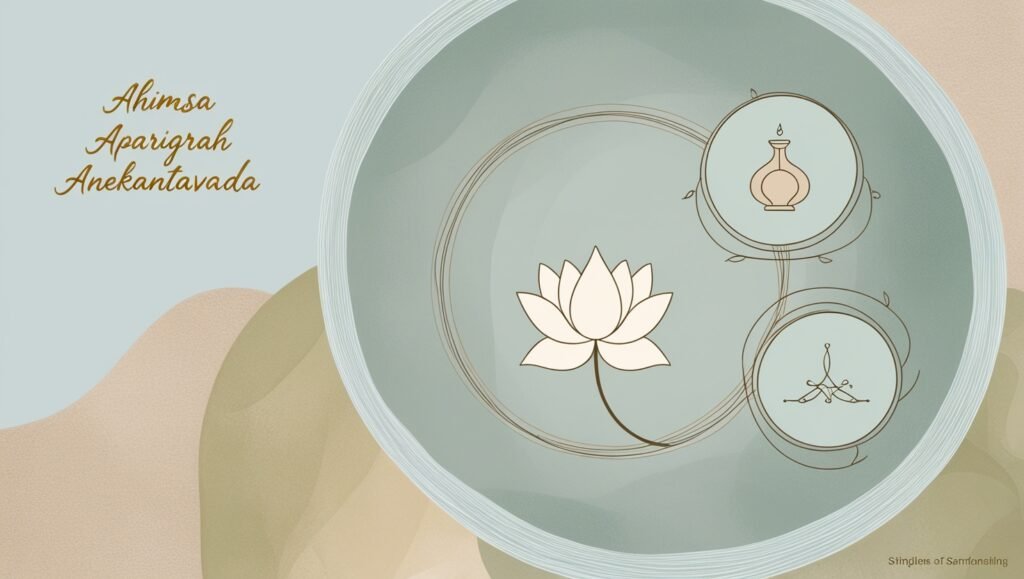
>Aparigraha(Non-Possession)
Mahavir Swami emphasised the need to avoid attachments to material possessions. The practice of Aparigraha, or non-possession helps individuals reduce desires, leading to contentment and spiritual progress.
Aparigraha encourages people to live with simplicity, only taking what is necessary for survival and giving up greed, thereby reducing karmic accumulation.
>Anekantavada (Multiplicity of Truths)
Mahavir Swami taught that reality is multifaceted and no single viewpoint can encompass the entire truth. Anekantavada asserts that individuals must respect and consider multiple perspectives. This teacjing fosters tolerance and open mindedness, encouraging dialogue and peaceful coexistence among different belief systems.
Jain Philosophy and Practices:
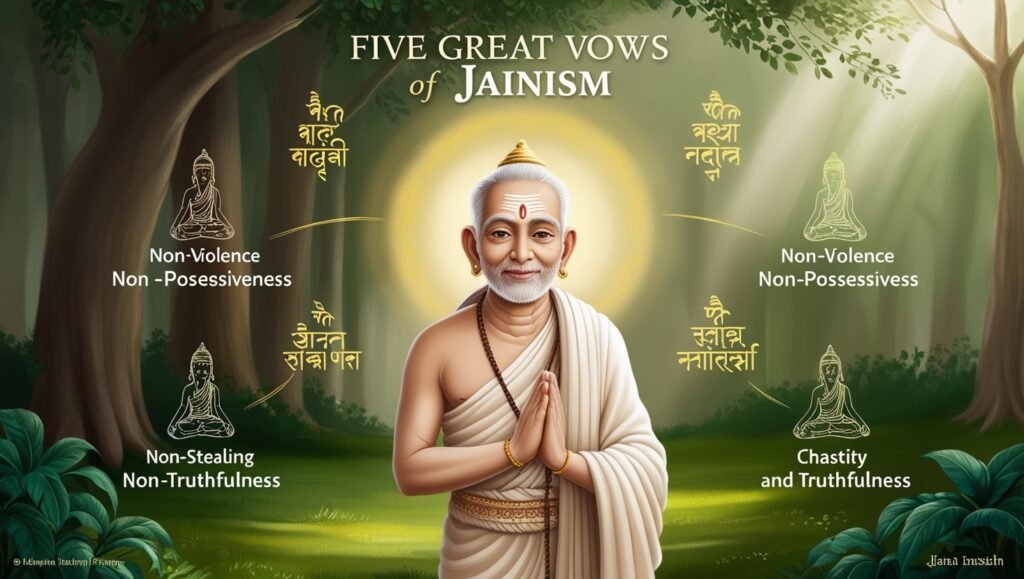
The Five Great Vows(Mahavratas)
- Ahimsa: Non – Violence in all forms, which forms the ethical foundation of Jainism.
- Satya(Truthfulness): Jains must always speak the truth and avoid falsehood.
- Asteya(Non-Stealing): Taking what is not given is strictly prohibited.
- Brahmacharya(Chastity): Complete celibacy for monks and faithful conduct for householders.
- Aparigraha: Non-attachment to material goods and desires.
The Concept of Karma
In Jainism, Karma is not merely a concept of actions and reactions but is believed to be a physical substance that attaches to the soul through actions, thoughts and desires Every soul is weighed down by karmic particles, and only through self-purification, ethical conduct and meditation can one cleanse the soul and achieve liberation(Moksha).
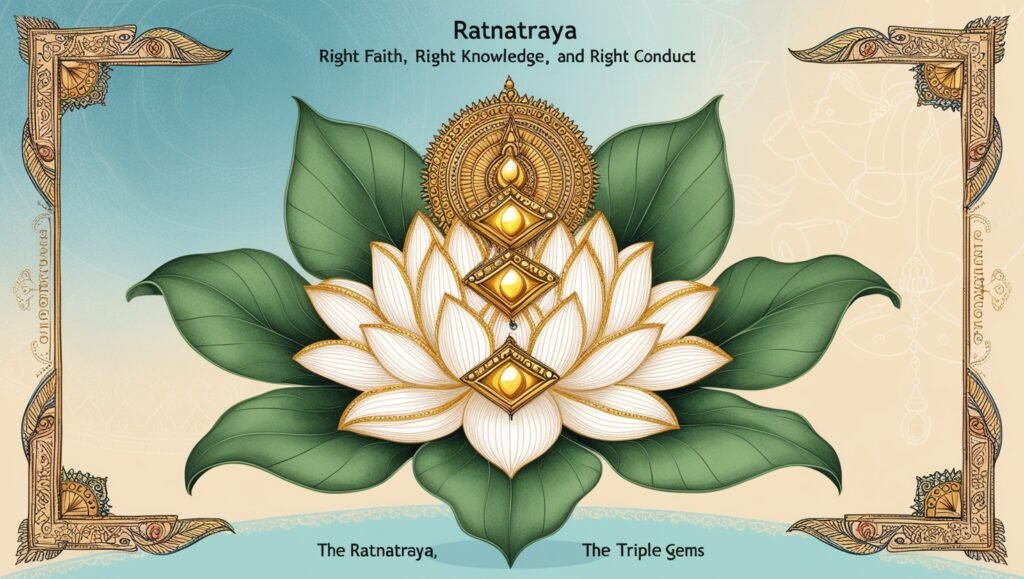
The Triple Gems(Ratnatraya)
- Samyak Darshana(Right Faith): A correct understanding and belief in the nature of the soul and the universe.
- Samyak Jnana(Right Knowledge): Clear knowledge of the Jain scriptures and spiritual truths.
- Samyak Charitra(Right Conduct): The application of Jain principles in daily life leading to purification and the eventual liberation of the soul.
Mahavir Swami’s Contribution to Jainism:
Formation of the Jain Sangha
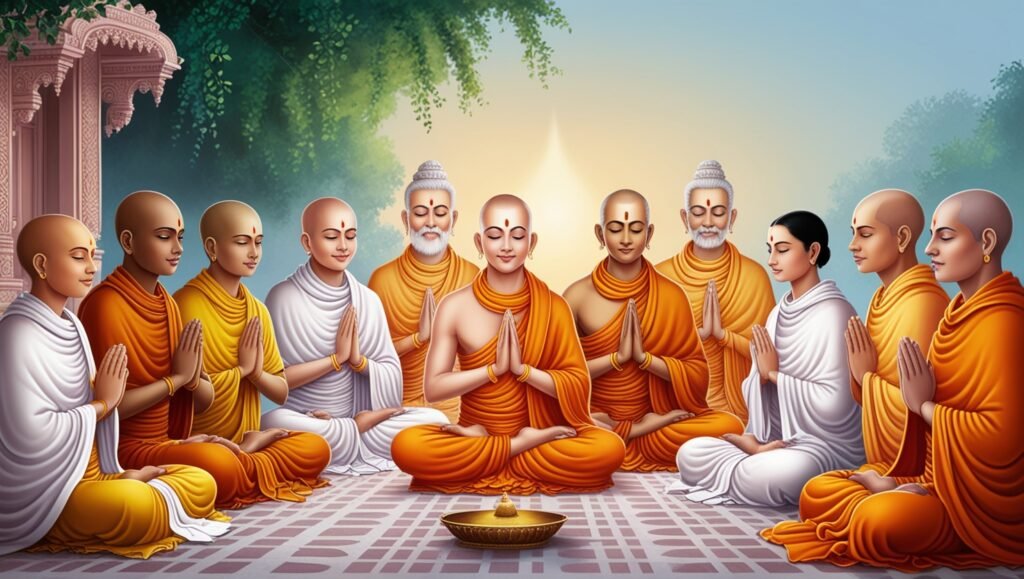
After attaining the enlightenment, Mahavir Swami formed the Jain Sangha, a community consisting of monks, nuns and lay followers. The Sangha spread his teachings far and wide across India, establishing the foundation structure of Jainism.
Mahavir’ teachings were accessible to all, irrespective of caste, class or gender. His egalitarian approach attracter followers from various walks of life.
The division of Jainism
After Mahavir swami’s death, Jainism gradually split and into two major sects-
- DIGAMBARA(Sky-Clad) and
- SVETAMBARA(White-Clad)
The sects differ on interpretations on Jain scriptures and ascetic practices, but both remain rooted in Mahavir Swami’s teachings.
Liberation and Legacy:
Attainment of Nirvana
In 527 BCE, at the age of 72, Mahavir Swami attained Nirvana in Pavapuri(Bihar). According to Jain beliefs, his soul was freed from the cycle of birth rebirth, reaching a state of eternal bliss.
The day Mahavir swami’ s attained Nirvana is celebrated as Diwali by jains, marking the victory of light(Knowledge) over darkness(Ignorance).
Impact on Indian Spirituality
Mahavir Swami’s teachings have had a lasting impact on Indian Spirituality, ethics and culture. His principle of Ahimsa greatly influenced later movements, including Gandhian Non-Violence during india’s independence struggle.
Jainism’s commitment to non-violence ,environmentalism and respect for all life has gained global recognition and Mahavir Swami’s teachings continue to inspire ethical living across the world.
The Essence of Jainism:
Spiritual Equality
Jainism teaches that all living beings, from the smallest microorganisms to human beings, possess a soul. Each soul has the potential to attain liberation through spiritual purification. The soul is eternal, indestructible, and is bound only by the limitations of karma. Once liberated, it attains infinite knowledge, preception and bliss.
The Path to Liberation
Jainism places immense responsibility on the individual. Liberation is self-driven, achieved by adhering to ethical conduct, practicing meditation and purifying the soul.
Jainism teaches that the cycle of birth, death and rebirth is driven by KARMA. Only by following the path of Mahavir Swami can one break free from this cycle and attain MOKSHA.
Conclusion:
Mahavir Swami’s life and teachings from the bedrock of Jain philosophy, offering a way of life that transcends time and culture. His teachings on non-violence, self-restrain, and compassion are more relevant than ever, guiding humanity toward ethical living respect for all life and spiritual freedom.
*Disclaimer:
Our website uses some AI-generated images to enhance the visual experience and illustrate content effectively. These images are created through artificial intelligence and may not always reflect real-life objects, people, or places. We aim to use AI images for artistic and educational purposes only. Please note that while we strive to ensure accuracy, some representations may vary or be symbolic in nature. The AI-generated images do not imply endorsements or affiliations with specific individuals or entities unless explicitly stated. For inquiries regarding image usage, or if you believe any content needs review, please feel free to contact us.